
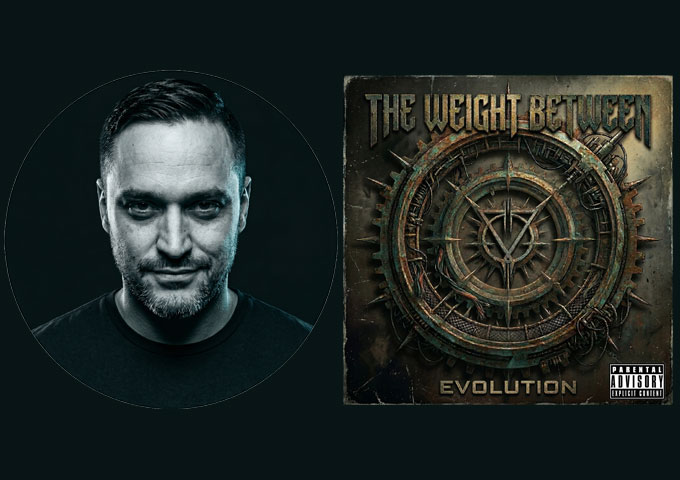
Evolution doesn’t offer comfort, and that’s precisely what makes it one of the most compelling debut records in recent memory. The Weight Between have constructed a ten-track arc that moves through collapse, damage, and discomfort without ever flinching toward a tidy ending. What arrives instead is something rarer and more honest: awareness, carried like a weight you’ve finally decided to stop running from.
There’s a moment on The Weight Between‘s debut record ‘Evolution’ where the whole project snaps into focus. It’s not when the drums crash in, not when the guitars go nuclear, and not even when the vocals tip from melodic to something rawer and more confrontational. It’s the quiet underneath it all. The deliberate pause before the next hit lands. That’s where Matthew Ahumada lives as a creative director, in the tension between what’s already broken and what’s about to be rebuilt. He built The Weight Between in that space, and ‘Evolution’ is what happens when someone stops hiding in it.
Let’s get something out of the way, because it’ll come up. The Weight Between makes music with AI. Matthew Ahumada is the sole human member. The band’s other identities, Sienna Knox on bass, Evan Cross on guitar, Jace Nolan on drums, and Ryan Vale on keyboards, are constructs, deliberate creative characters that give shape and personality to each sonic role in the project. Some people will decide that disqualifies TWB from serious consideration before the first track ends. That’s their call. But the conversation about whether this is “real” music lands a lot softer when you’re actually listening to it, because whatever process produced these songs, the emotional architecture inside them is entirely human. Pain this specific doesn’t come from a button press.
‘Evolution’ opens with “Dear Me,” and it hits like a reckoning addressed to the version of yourself you’d most prefer to forget. This isn’t nostalgia. It’s more like sitting across from your past and refusing to flinch. The track tears through the mythology of youthful self-destruction, the chemical shortcuts, the performative bravado, the fleeting rush of viral validation, and doesn’t romanticize any of it. The narrator isn’t mourning who he was. He’s autopsying him. The shift at the song’s core, trading the powder for the pen, stopping trying to die impressive and choosing instead to live aggressive, sets the album’s entire thesis in place before the second track even breathes. True recovery isn’t resolution. It’s awareness. And awareness is brutal.
“Baseline Heartbeat” follows, and it does something surprisingly physical. After the wreckage of the opener, the song doesn’t reach for peace. It reaches for the body. The weight of heavy music itself becomes the stabilizer, a racing pulse reframed as something structural rather than symptomatic. When the mind goes quiet in the wrong way, the low end keeps the system in check. It’s a fascinating inversion; surrendering control to a rhythm so you don’t lose it somewhere more dangerous.

Then “Static In My Headphones” descends into isolation, and this is where Evolution starts revealing how conceptually tight it really is. The white noise isn’t escapism. It’s armor. Wearing weight in decibels. Giving the darkness a rhythm so it stops being formless. Industrial music as mechanized survival rather than aggression for its own sake. The song captures something that rarely gets said plainly: sometimes noise is quieter than your own mind, and there’s nothing irrational about preferring it.
“Mirror Damage” crashes in slow and heavy, all crushing atmospherics and deliberate unease. It doesn’t announce itself. It just presses down. The song examines distorted self-perception and the emotional damage caused by facing a reflection that no longer feels familiar. Its weight comes from allowing tension to build until the impact becomes unavoidable.
“Borrowed Skin” is the album’s most psychologically precise moment. Depersonalization is one of those experiences that’s incredibly common and almost impossible to describe without sounding like you’re exaggerating, and this track doesn’t bother with polite framing. The horror of faking mental health as a daily performance, of conversations reduced to copy-paste scripts, of feeling like a passenger in your own existence, all of it builds toward something that feels more like a violent refusal than a breakthrough. Bleeding authentically instead of surviving as a ghost. The industrial crescendo earns it.
“The Comeback” strips that momentum back down to something raw. It’s an autopsy of addiction, and it doesn’t editorialize. The initial relief, that first artificial mercy from psychological weight, is rendered almost tenderly before the track maps the trajectory forward into everything the narrator traded for it. Paying interest just to feel alive. The industrial rap-rock framework suits the subject in a way that softer production never could. There’s grit in the instrumental bed that matches the content without underlining it.
“Still Breathing” is the pivot the whole record has been building toward, and it earns its place as the turning point specifically because it refuses to clean anything up. Depression framed as a war inside your blood. The space between giving up and pressing forward rendered as something genuinely exhausting rather than cinematic. The defiance here isn’t triumphant, it’s stubborn and tired and real. Survival isn’t the absence of pain. It’s the choice to keep breathing despite its presence. Cheap resolution would have killed this song. The album is better for denying it.
“Process Over People” throbs and bangs with that industrial grit, the vocals pulling upward with a kind of irresistible tidal force. It’s the moment the record shifts register before the final surge. The song explores the damage caused when systems, expectations, and ambition begin to overshadow human connection. Its heavy rhythm and commanding delivery create one of the album’s most confrontational moments.
Then “Evolution” arrives, the penultimate track and arguably the most politically charged thing on the album. This is where Matthew Ahumada turns the project’s meta-narrative into fuel. The vultures who called him a washed-up one-hit wonder, the dismissals, the labels, the whole architecture of a music industry that decides your expiration date for you. The narrator doesn’t refute them politely. He weaponizes their skepticism and builds with it. The integration of AI into the creative process gets addressed directly, machines as tools that drag thunder through wires rather than shortcuts, and shedding the former alias Whitebread to emerge as The Weight Between. It’s a song about becoming something the old version of you couldn’t have survived being. Evolution isn’t transformation, it’s adaptation forged in backlash.
The self-titled closer “The Weight Between” doesn’t try to top any of that. It doesn’t need to. What it does instead is settle. The narrator steps out of the wreckage of addiction and performance and viral moments and industry dismissal and lands somewhere quieter, choosing to live in the balance rather than outrun the scars. The titular phrase does something unusual here; it doesn’t position the weight as a burden to eventually set down. It conceptualizes the heavy liminal space between surviving and becoming as the only place where meaning actually lives. You don’t find yourself by getting lighter. You find yourself by deciding to carry it anyway.

Evolution is a debut that sounds like it was already overdue. Across its ten tracks, the alt-rock explosiveness and nu-metal power and industrial rap-rock confrontation and moments of genuine melodic lift serve a record that knows exactly what it’s about. This isn’t a genre exercise. It’s an origin story, and a genuinely unsettling one, that refuses to manufacture comfort at any stage.
The Weight Between‘s second album, Complicit, drops July 3rd, and if the debut is the inside of a breaking mind choosing to stay conscious, Complicit sounds like it’s going to aim that same unflinching gaze outward at the systems that break people to begin with. Whatever it turns out to be, one thing is already clear. Matthew Ahumada didn’t build this project to ask for anyone’s permission. He built it to make you feel something you can’t immediately explain and then argue about it on the drive home. On the evidence of Evolution, he’s already doing exactly that.
OFFICIAL LINKS:
Website – www.theweightbetween.com
Spotify – https://open.spotify.com/artist/7b9rvtDzQRRz8ewig6Vvmr?si=GpLHZe2UQlGo0Dzy7lEWzA
SoundCloud – https://on.soundcloud.com/0KKAQA9iJ4oHqbcGbD
Apple – https://music.apple.com/us/artist/the-weight-between/1873728798
YouTube – https://www.youtube.com/@TheWeightBetweenBand
Facebook – https://www.facebook.com/TheWeightBetween
Instagram – https://www.instagram.com/theweightbetweenband
You may also like
-
Circus Mind’s “Road Less Traveled” Proves a Band Can Wander Everywhere and Still Sound Like Themselves
-
Six Versions, One Vision: Take The W Makes a Bold Statement With Show Me Love (Club Banger Remixes)
-
“Plugged” In and Paid Up: How Playboipaid’s New Single and “4evapaid Compilation” Are Rewriting Milwaukee’s Rap Narrative
-
Magnetic Intrusion Ascends to New Creative Heights with the Blazing New Single “The Seraphim”
-
WT Serves Up “Sweet Music” and “Dirty Cafe”: Two Singles That Demand Your Attention