

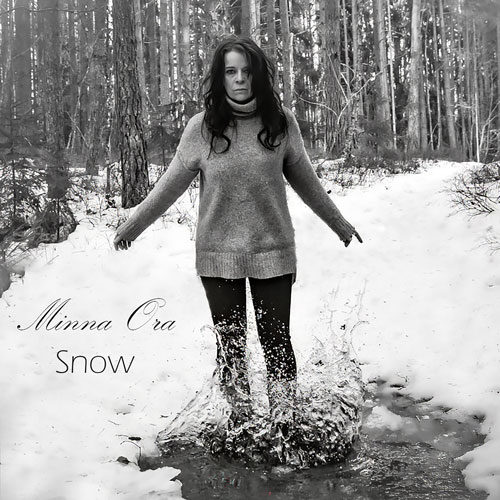
With “Snow,” Finnish singer-songwriter Minna Ora confronts the difficult questions surrounding fate and personal choice. Three portraits of individuals experiencing hardship provide the emotional foundation for a compelling exploration of loneliness and vulnerability. The song’s recurring reflections on alternative paths invite listeners to consider how differently their own lives might have unfolded. Warm acoustic textures and expressive vocals reinforce its intimate, contemplative atmosphere. Beneath its melancholic exterior, the composition carries an encouraging message about the possibility of choosing a different future.
Finnish singer-songwriter Minna Ora has developed a distinctive artistic identity through music that explores the relationship between nature, spirituality, human vulnerability, and the mysteries that exist beyond our immediate understanding. Her eighth solo single, “Snow,” continues that journey with one of her most emotionally revealing compositions to date. Available in both English as “Snow” and Finnish as “Lumi,” the release takes an unflinching look at loneliness, the weight of life’s circumstances, and the questions that emerge when we consider how differently our stories might have unfolded.
At the heart of the song is a deceptively simple question: what if one decision had been different? What if, at a particular moment, we had chosen another direction, taken another road, or stepped somewhere else entirely? This recurring reflection becomes the emotional foundation of “Snow,” opening up a much larger conversation about fate, personal responsibility, coincidence, and the countless possibilities that exist within a human life. Rather than treating these questions as abstract philosophical exercises, Minna Ora approaches them through the experiences of people whose circumstances have placed ordinary happiness beyond reach.
The lyrics introduce three distinct individuals, each carrying a different form of hardship. One is imprisoned, another depends on a walking aid and silently cries out for assistance, while a third searches for somewhere safe to spend the night, longing for nothing more complicated than warmth and rest. These brief portraits are presented without unnecessary explanation or sentimental embellishment. Their situations highlight different expressions of vulnerability, reminding listeners that suffering and isolation are not always immediately apparent to the outside world.
The recurring image of someone accidentally stepping into a puddle, changing the color of the water, adds an intriguing symbolic dimension. A seemingly insignificant incident becomes a recurring detail connecting the three stories, suggesting how ordinary moments can acquire unexpected significance when viewed through hindsight. The altered water also reinforces the song’s interest in life’s unpredictable changes, where circumstances can shift without warning and the consequences may extend far beyond the original moment.
What makes this storytelling effective is the absence of easy judgment. “Snow” does not attempt to explain why these individuals have reached their respective situations, nor does it suggest that every hardship can be overcome through determination alone. Instead, it invites listeners to consider the uncomfortable possibility that circumstances, accidents, and decisions can combine in ways that fundamentally alter a person’s future. The central question about taking a different direction consequently carries considerable emotional weight. It is not simply about regretting past decisions, but about imagining the entirely different identity and existence that might have emerged from another sequence of events.
The arrival of the chorus introduces a contrasting emotional perspective. The falling snow initially appears heavy and gray, challenging the traditional association of winter with pristine beauty and peaceful landscapes. Yet Ora introduces an unexpected image of countless butterflies filling the sky, bringing a sense of movement and possibility into an otherwise bleak setting. The butterflies, traditionally associated with metamorphosis and renewal, complement the song’s broader exploration of change without making its message overly optimistic.
The image of flying freely within one’s mind develops this idea further, establishing imagination as a refuge when physical circumstances offer little opportunity for escape. For someone imprisoned, struggling with disability, or without a place to call home, the ability to imagine another existence becomes an important form of psychological freedom. The song does not pretend that imagination removes these difficulties, but recognizes that the inner world can preserve possibilities that reality has temporarily denied.
When the narrative eventually moves into the first-person reflection, the emotional distance between observer and subject begins to disappear. The question about having chosen another direction becomes intensely personal, inviting listeners to examine their own histories and the moments they continue to revisit. The narrator’s frustrated contemplation of where life might have led under different circumstances gives the song an especially human quality. Almost everyone has experienced the temptation to rewrite a particular moment, wondering whether a different decision might have prevented disappointment or opened the door to something better.
Yet “Snow” does not allow regret to become its final destination. The narrator’s declaration of mental flight introduces a more hopeful perspective, before the closing image of a landscape that might eventually shine snow-white brings the composition towards resolution. The contrast between the earlier dirty, gray snowfall and the possibility of a clean white surface suggests that a new beginning remains imaginable, even after a difficult past. It is an understated but meaningful conclusion that leaves room for personal interpretation.
Musically, “Snow” complements its lyrical depth through an intimate, atmospheric folk-pop and singer-songwriter arrangement. Warm acoustic guitar textures provide the foundation, while gentle keyboard and synth elements introduce additional depth without overwhelming the composition. The production remains deliberately spacious, allowing the storytelling to breathe and giving the instrumental details room to reinforce the song’s wintry atmosphere. Delicate vocal harmonies and subtle atmospheric echoes contribute to the emotional development, while the swelling choruses provide a natural sense of expansion as the central themes become increasingly prominent.
Minna Ora’s vocal delivery is equally important to the track’s effectiveness. Rather than relying on excessive dramatization, she adopts an expressive, measured approach that allows the underlying emotions to emerge gradually. There is an understated melancholy in the performance, but also a sense of quiet determination that becomes more apparent as the song progresses. The contrast between the restrained verses and more expansive choruses mirrors the movement from observing other people’s suffering toward recognizing the possibility of personal renewal. The production never competes with the lyrics for attention, maintaining the intimacy necessary for the song’s reflective character.
An additional dimension to Ora’s artistic identity lies in her completely independent creative process. She writes the music and lyrics, arranges, records, and produces every one of her solo releases herself. This comprehensive involvement gives her work a clear sense of personal authorship, with each musical and production decision contributing to a unified artistic vision. Her continuing series of nature-inspired singles, including “Metsä (Forest),” “Meri (Sea),” “Tuuli (Wind),” “Tuli (Fire),” “Myrsky (Storm),” “Viima (Freeze),” and “Kallio (Rock),” establishes an imaginative connection between the natural environment and the emotional experiences of human existence. These releases have attracted attention and reviews beyond Finland, and “Snow” extends that creative exploration with a particularly thoughtful examination of life’s uncertainties.
Ultimately, “Snow” is a song about the difference between the life we inhabit and the life we continue to imagine. Its understanding of loneliness extends beyond physical isolation, recognizing the emotional consequences of circumstances that can separate people from the ordinary experiences others might take for granted. Nevertheless, Minna Ora refuses to leave the listener trapped within that darkness. Her closing vision offers permission to hope, reconsider, and believe that the future might still contain opportunities that the past could not provide.
With “Snow,” Minna Ora delivers an intimate and contemplative composition that finds unexpected depth in difficult questions. It reminds us that while we cannot always choose the circumstances that shape our lives, we can continue imagining what might come next. Sometimes, the most meaningful new beginning starts with the willingness to believe that the landscape ahead can still change.
You may also like
-
Beyond Genre Boundaries: Sensor Noise Create a Dreamlike Musical Adventure on “Sweet Tooth”
-
Baad Krio and Amie Kallon Bring Sierra Leone’s Musical Identity to the Forefront on “Monjama”
-
Euplasia’s “Forever Remember” Celebrates the Everyday Moments That Become Lifelong Memories
-
A140’s “Castles In The Sky” Transforms Love, Memory and Loss Into a Powerful Hip-Hop Journey
-
a Maria’s “My Instagram View” Turns Romantic Frustration Into Pop Power